KidZania Mumbai With My Daughter: Homeschooling perspective
KidZania Mumbai Through a Homeschooling Lens
KidZania has nearly 30 indoor, interactive learning and role-play centers across 22 countries. In India, there are currently two locations—KidZania Mumbai at R City Mall, Ghatkopar West, and KidZania Delhi NCR at Entertainment City.
KidZania is designed like a miniature city, built especially for children. It has its own streets, buildings, shops, workplaces and vehicles, creating an environment that feels like a real city on a smaller scale. Children can step into different professions and take part in hands-on activities inspired by real workplaces, from healthcare and food preparation to aviation, banking and other services.
What makes the experience interesting is that children aren’t just watching these professions—they actually get to role-play them, follow instructions, interact with others and experience how different jobs work.
As children take part in different activities, they can earn KidZos, the currency used inside KidZania. They can then use what they earn for various experiences and purchases within the city. Parents aren’t allowed to accompany children into every activity zone, but the facility provides ways for parents to keep an eye on their children while they explore independently.
Global Presence
KidZania has a presence across several parts of the world, with interactive centers located in Asia, the Americas, Europe and the Middle East.
- Asia: Japan, South Korea, Malaysia, Singapore, Indonesia, Vietnam, Qatar and Kuwait.
- Americas: Mexico and the United States.
- Europe & Middle East: United Arab Emirates, Egypt, Turkey, Portugal and Saudi Arabia.
Each location follows the same basic concept of creating a child-sized city where children can explore different professions through hands-on role-play and interactive activities.
1. Introduction—Learning Beyond the Homeschool Room
We often think of homeschooling as books, worksheets and lessons at the dining table. But some of the most meaningful learning happens when children step outside, interact with people and experience the world for themselves.
We chose to visit KidZania Mumbai as a field trip for my daughter, especially because she is homeschooled. I wanted her to experience learning through role play, interaction and real-world activities rather than just reading about them. We deliberately visited on a weekday, hoping for fewer crowds and more opportunities for hands-on learning.
2. Why We Chose KidZania as a Homeschooling Experience
At this stage, I was looking for her learning exposure to be filled with questions, patience, curiosity, communication and real-world experiences—rather than simply completing lessons or collecting information.
- Real-world exposure
- Role play and practical learning
- Social interaction
- Understanding how different professions work
- Opportunities to make decisions independently
These were the points I was looking for and were covered almost 100% through the experience—since my daughter is a quick learner with a good grasping ability, she was able to understand the activities and instructions easily, and we faced no difficulty throughout the experience.
3. Learning About Money Through the Bank
We started at the bank, where my daughter received her KidZos—the currency used inside KidZania. It was a simple but practical introduction to money, earning and decision-making, making financial learning feel much more real than a textbook lesson.
Benefits in Homeschooling: –
- Understanding money
- Earning and spending
- Basic financial literacy
- Following a system independently
- Learning that money has value because of work
How to use KidZo’sAt the bank, children receive KidZos, KidZania’s own currency. |
4. Exploring Different Careers Through Role Play
My daughter experienced different professional roles & also earned some KidZos, such as:
- Pilot
- Cheese maker
- Architect
- Chef
- Engineer
- Animator
- Artist
- Doctor
- Pet Rescuer
- Teacher
- Firefighters
- Food-production roles
- Other jobs and activities
This is how role play allowed her to experience a profession rather than simply read about it in a textbook.
5. The Pilot Experience — Imagination Meets Learning
Parents aren’t allowed inside the activity zones, so I had to watch my daughter through the CCTV screens while she took on her role as a pilot. It was actually lovely to watch her confidently follow the activity on her own, without me standing beside her.
She was completely immersed in pretending to be a pilot, and when you asked how she felt, she said she felt like a real pilot.
Children don’t always need a worksheet to understand a concept. Sometimes stepping into a role allows them to understand it emotionally, socially and practically.
6. Learning About Food Production at Britannia
The cheese-making activity was one of the most hands-on experiences. She took on the role of a little cheese maker, listened to the instructions, and followed the process step by step. At the same time, she was interacting with other children, listening, cooperating and sharing the space—giving her a natural opportunity to practice social skills, which in school terms is called ‘socialization.‘
For a homeschooler, this is exactly the kind of real-world learning I look for: following instructions, understanding a process, working alongside others and learning to communicate independently.
- Where food comes from
- Manufacturing
- Following instructions
- Hygiene
- Teamwork
- Understanding the journey from ingredients to finished product
Socialization is not simply about putting children together in a classroom. A classroom can teach lessons, complete worksheets and prepare children for exams, but real-world socialization is much broader. It is about interacting with people with different personalities, mindsets and levels of patience—while learning to communicate, cooperate, manage frustration and show kindness within a given situation. For a child who is already naturally kind and compassionate, these experiences become less about being taught how to socialize and more about actually understanding and practising what socialization means in real life.
7. Listening Is a Skill Too
In the vlog attached below, you can clearly see how patiently my daughter listens, remembers the instructions and follows them through to completion. For us, this is where homeschooling becomes meaningful—learning to listen patiently, understand instructions, remember them and put them into action in a real-world setting.
For me, these are not skills that belong only to academics. They come into play while doing a science experiment, helping in the kitchen, making something with her hands, going on a field trip, or even handling simple things in everyday life. These everyday experiences are a big part of our homeschooling too.
To patiently listen, understand, remember and follow a sequence of instructions is itself a learning skill.
8. Socialization in the Real World
My daughter has experienced both school life and homeschooling, which gave her the opportunity to understand the difference for herself. Over time, that exposure gave her the clarity to choose what she felt was right for her. And as a parent, I see my role as giving her the right guidance, exposing her to different possibilities and allowing her to make an informed choice.
I don’t see this as school versus homeschooling. Children can learn social skills in many different environments. For us, homeschooling simply gives me the flexibility to create more opportunities for her to experience different people, situations and real-world interactions at her own pace.
Socialization isn’t simply sitting in a room surrounded by children of the same age. Real-world socialization involves meeting different people, listening to adults, communicating with strangers, working alongside other children and learning how to function in unfamiliar environments.
9. One-to-One Interaction—Exactly What I Was Looking For
We chose to visit on a weekday, so some of the zones were relatively less crowded. This gave my daughter more time to interact with the facilitators, ask questions and receive individual attention when needed. We spent more than six hours inside, and by the end, she was physically exhausted, but her mind was still ready to explore more. We finally decided to head back home—not because she had had enough, but because her little body had.
The lack of crowds in certain activities turned out to be an unexpected advantage. She could listen, ask questions, observe closely and receive one-to-one guidance instead of simply moving through an activity with a large group.
10. Crafting, Creating and Feeling Proud
She participated enthusiastically in every activity and earned her KidZos along the way. The crafting activity was especially rewarding—she followed the steps patiently, used her creativity and created something with her own hands. Seeing her proudly look at what she had made, knowing she had earned those KidZos through her own efforts, was a lovely part of the experience.
- Fine motor skills
- Creativity
- Following a process
- Patience
- Sense of achievement
The important part isn’t merely what she made.
It’s that she could look at something and say, essentially, “I made this & earned it”
11. Learning About Animals and Compassion
The pet rescue agency activity was another interesting experience for her. She got to understand how caring for animals can also be a responsibility and a profession. It was a simple way to bring kindness, empathy and real-world awareness into the learning experience.
This is the kind of real-world learning I want to include in our homeschooling journey.
- Animal care
- Empathy
- Responsibility
- Understanding community services
- Learning about careers involving animals
The real lesson went beyond the activity—it was about understanding responsibility, showing empathy and learning to care for what matters.
12. Learning About Currency and Bringing Money Home
She came home with the KidZos she had earned through the different activities, which made the whole experience feel even more real. It gave us a simple opportunity to talk about earning, saving, spending and making choices with money. For me, this is another homeschooling lesson that can naturally continue at home, long after the field trip is over.
A homeschool lesson that helped her understand:
earning → saving → spending → decision-making.
The KidZos also reminded me of something we had already been doing at home. During summer, we made homemade ice cream and cupcakes, and my daughter took on the little job of making the cones and filling the ice cream. We turned it into a pretend ice-cream-selling activity, and in return, we gave her some real cash as her “earning.” She then took that money to the supermarket and used it to buy something for herself.
From earning the money to shopping, paying at the counter, and coming home with a satisfied heart, she got to see how money actually flows in everyday life. For me, this is what homeschooling can look like—turning something as simple as ice cream into a lesson about earning, spending, choices and independence.
13. We Couldn’t Cover Everything—Even on a Weekday
We spent almost six hours inside KidZania, and honestly, by the end, our feet were done! There were only a few things left, but they were all casual and not on my daughter’s priority list. The amount of standing and walking eventually made us decide to head back home. What was funny was that physically we were exhausted, but mentally my daughter was still excited and ready to explore more.
We went on a weekday expecting that we would have plenty of time to explore everything. We were wrong. There was still so much to see and do that we couldn’t cover it all.
There was still so much left to see and do, which made us realize that KidZania is better experienced at your own pace rather than trying to tick every activity off a list.
14. What My Daughter Actually Learned
Academic learning |
Life skills |
Social-emotional learning |
|
|
|
|
|
|
|
|
|
|
|
|
|
|
|
15. Is KidZania Worth It for Homeschoolers?
For us, yes—not because KidZania replaces academic learning, but because it complements it in a way that books and worksheets simply cannot.
My daughter got to step into different roles, interact with people, follow instructions, make decisions, handle money, work with others and experience how different professions function.
What I liked most was that the learning didn’t feel forced. She was learning while doing, observing, communicating and making her own choices. As a homeschooler, these real-world experiences are an important part of how I want her education to grow.
So for me, KidZania wasn’t just a place to play. It was a field trip where learning happened naturally—and that is exactly why I would consider visiting again.
16. Final Thoughts—Why Real-Life Learning Is Part of Our Homeschool
Homeschooling, for us, isn’t about recreating a classroom at home. It’s about giving our daughter opportunities to learn wherever learning naturally happens—at home, in a kitchen, in a museum, at a workplace simulation, through conversations and out in the world.
Sometimes the best classroom is simply a place where a child gets to experience life.
Links to read my other article related to homeschooling
What led us to homeschool our daughter—part 1
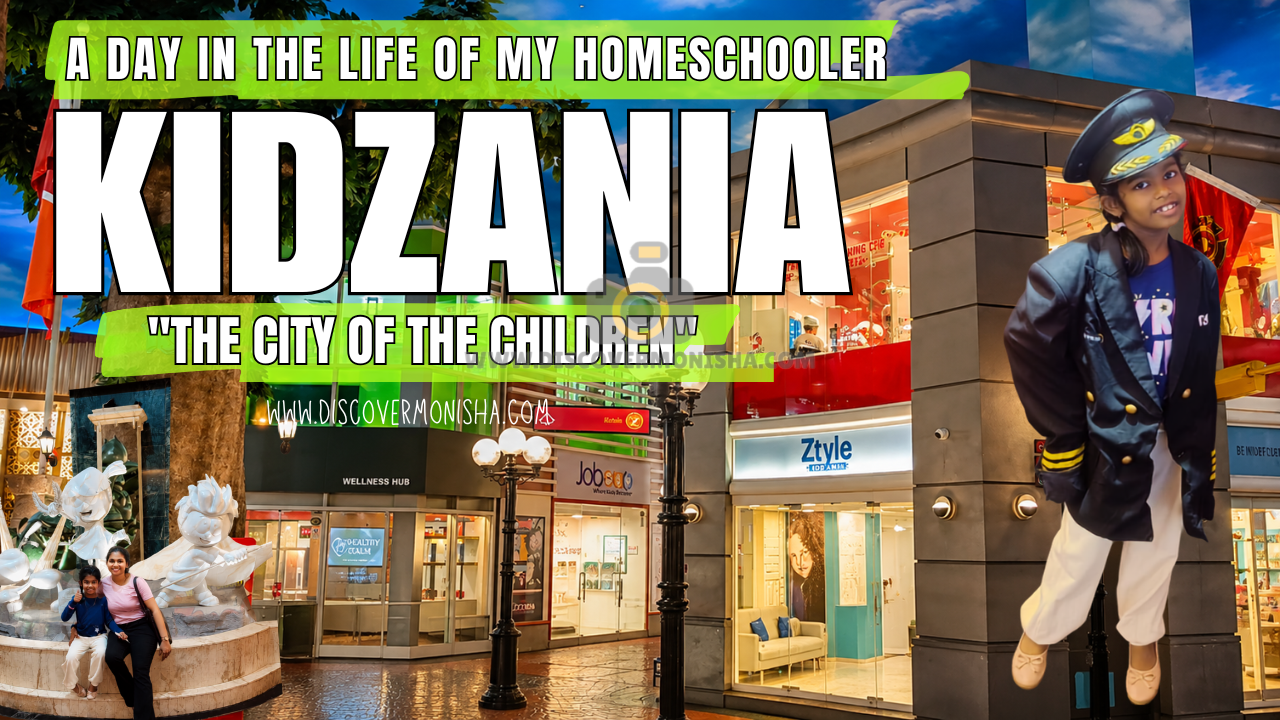
A small visuals featuring our day in KidZania, Mumbai