
Don’t confuse schooling with education
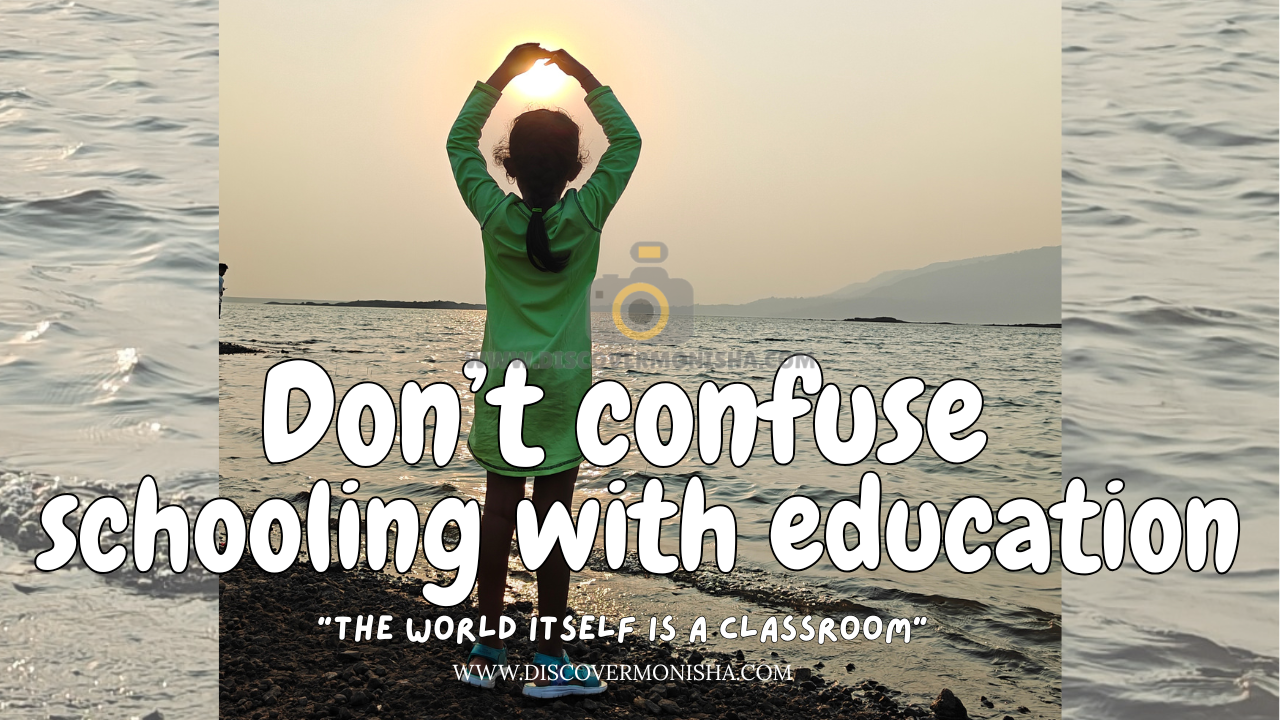
Don’t Confuse Schooling with Education
Introduction
But education is the lifelong process of learning, understanding, and growing.”
What is Schooling?
It includes classrooms, curriculum, standardized exams, and academic milestones.
-
Schooling is the formal system through which children receive structured instruction within classrooms, following a fixed curriculum and timetable.
-
It is designed to deliver academic knowledge through textbooks, lessons, examinations, and standardized evaluation methods.
-
In schooling, learning often happens within the boundaries of subjects such as mathematics, science, language, and social studies.
-
The focus is usually on completing syllabi, scoring marks, and progressing through different grade levels.
-
Schools also provide a social environment where children interact with peers, follow rules, and learn discipline within an organized setting.
-
However, schooling mainly measures how well a child performs academically rather than how deeply they understand life beyond textbooks.
Key characteristics of schooling
- Fixed schedules and classroom environments.
- Standardized learning materials.
- Evaluation through grades and tests.
- A focus on completing a curriculum within a set time.
What is education?
It is the process of developing the mind, character, and perspective of a person.
- Education goes far beyond textbooks and classrooms.
- It is the lifelong process of learning how to think, question, understand, and grow as a human being.
- Education helps a person develop values, wisdom, creativity, and the ability to make thoughtful decisions in life. It teaches children not just what to learn, but how to learn and why it matters.
- Real education shapes character, builds empathy, and prepares a person to face real-world challenges.
- Unlike schooling, education continues everywhere — at home, in society, through experiences, and through reflection.
Key characteristics of education.
- while traveling to new places.
- during conversations with family.
- through art, creativity, and hobbies.
- by observing people and nature.
- through challenges and real-life experiences.
The World as a Classroom
Why is this difference important?
- When we confuse schooling with education, we risk believing that learning only happens inside institutions. But true education is a continuous journey.
- A child who is curious, thoughtful, and eager to explore the world is already receiving a powerful education—whether it happens in a classroom or beyond it.
Conclusion
Schooling is only one path toward learning, but education is a lifelong journey.
The most meaningful lessons often come from experiences, relationships,
and the courage to explore the world with an open mind.
When we leave school, it stays with us for the rest of our lives.