https://www.discovermonisha.com
  • Login
  • Register
  • Home
  • Recipes
    • Breakfast
    • Baking
    • Chaat Recipes
    • Desserts / Sweets
    • Main course
      • South Specials (Tamil Nadu)
      • Indian Meal Plates combination & Platters
      • Paratha / Roti / Rolls
      • Sabzi / Curry / Gravy
      • Continental
      • Non – Veg recipe
      • Snacks
      • Soups
  • Lifestyle
    • Hair and skin
    • Informative & Reviews
    • Motivational Topics
  • Travel
  • Parenting & Childcare
  • Occasion
  • Product Links
  • Architecture & Decor
  • Home
  • Recipes
    • Breakfast
    • Baking
    • Chaat Recipes
    • Desserts / Sweets
    • Main course
      • South Specials (Tamil Nadu)
      • Indian Meal Plates combination & Platters
      • Paratha / Roti / Rolls
      • Sabzi / Curry / Gravy
      • Continental
      • Non – Veg recipe
      • Snacks
      • Soups
  • Lifestyle
    • Hair and skin
    • Informative & Reviews
    • Motivational Topics
  • Travel
  • Parenting & Childcare
  • Occasion
  • Product Links
  • Architecture & Decor
  • Home
  • Parenting & Childcare
  • Don’t confuse schooling with education

Don’t confuse schooling with education
Posted on Mar 17th, 2026
by Monisha
Categories:
  • Parenting & Childcare
don’t confuse schooling with education (1)

Don’t Confuse Schooling with Education

Introduction

In a world where grades, report cards, and classrooms often define success, we sometimes forget that schooling and education are not the same thing. Rather, it is-
“Schooling is a system designed to deliver information,
But education is the lifelong process of learning, understanding, and growing.”
As a mother who chose homeschooling for my daughter, this quote resonated deeply with me. It reminded me that learning does not only happen through textbooks but also through experiences, conversations, and everyday life
For parents, especially those who choose alternative paths like homeschooling, this realization can be transformative. Education is not confined within classroom walls. It thrives on curiosity, experiences, conversations, and the courage to explore the world beyond textbooks.

What is Schooling?

Schooling is the structured framework society uses to teach children.
It includes classrooms, curriculum, standardized exams, and academic milestones.
  • Schooling is the formal system through which children receive structured instruction within classrooms, following a fixed curriculum and timetable.

  • It is designed to deliver academic knowledge through textbooks, lessons, examinations, and standardized evaluation methods.

  • In schooling, learning often happens within the boundaries of subjects such as mathematics, science, language, and social studies.

  • The focus is usually on completing syllabi, scoring marks, and progressing through different grade levels.

  • Schools also provide a social environment where children interact with peers, follow rules, and learn discipline within an organized setting.

  • However, schooling mainly measures how well a child performs academically rather than how deeply they understand life beyond textbooks.

Key characteristics of schooling

  • Fixed schedules and classroom environments.
  • Standardized learning materials.
  • Evaluation through grades and tests.
  • A focus on completing a curriculum within a set time.
Schooling provides structure and foundational knowledge. However, it often emphasizes memorization and academic performance more than understanding and curiosity.

What is education?

Education goes far beyond formal institutions.
It is the process of developing the mind, character, and perspective of a person.
  • Education goes far beyond textbooks and classrooms.
  • It is the lifelong process of learning how to think, question, understand, and grow as a human being.
  • Education helps a person develop values, wisdom, creativity, and the ability to make thoughtful decisions in life. It teaches children not just what to learn, but how to learn and why it matters.
  • Real education shapes character, builds empathy, and prepares a person to face real-world challenges.
  • Unlike schooling, education continues everywhere — at home, in society, through experiences, and through reflection.

Key characteristics of  education.

Learning:
  • while traveling to new places.
  • during conversations with family.
  • through art, creativity, and hobbies.
  • by observing people and nature.
  • through challenges and real-life experiences.
Education is about learning how to think, not just what to think.

The World as a Classroom

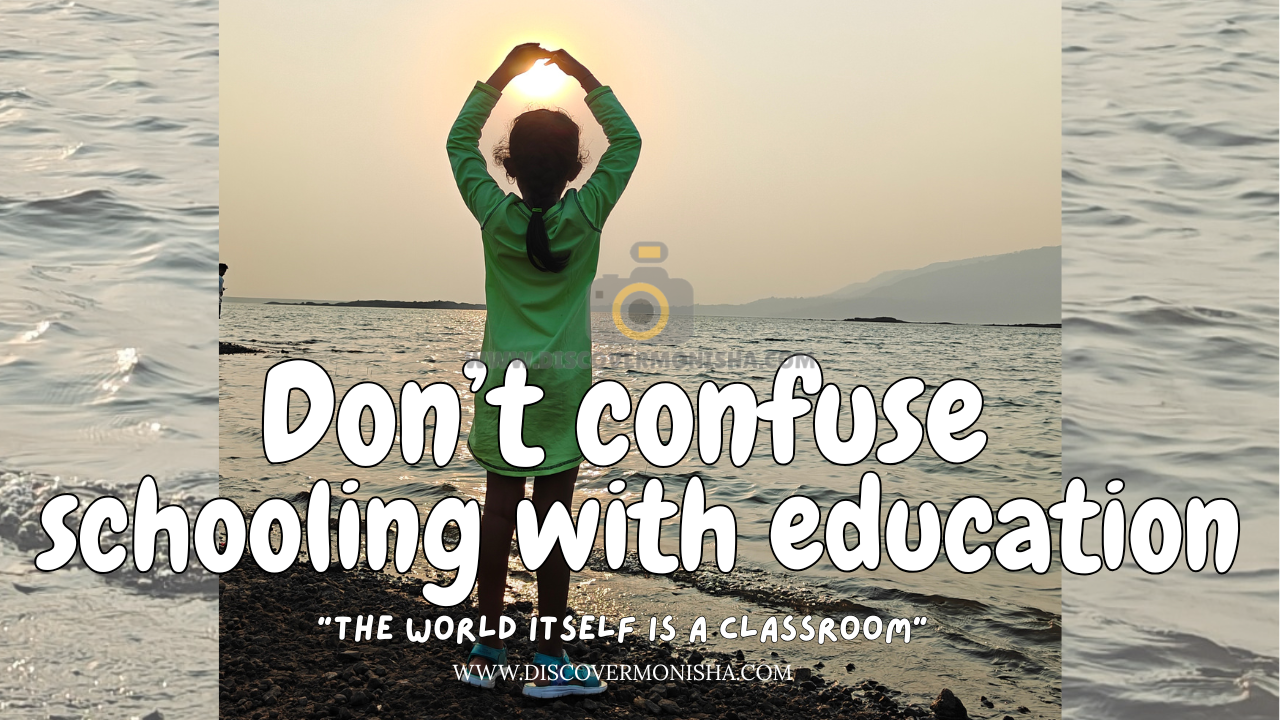
When we stop limiting the idea that learning can only take place in a classroom, we begin to see the bigger picture and realize that the entire world is a classroom.
A visit to a museum teaches history. A circus performance teaches timing, discipline and courage. Cooking together teaches patience, measurement, and creativity. Even everyday conversations can shape values and understanding. Nature walks can spark curiosity about the world, teaching children to observe, question, and appreciate their surroundings.
For a child, these experiences nurture curiosity, independence, and emotional intelligence—qualities that cannot always be measured by exams.

Why is this difference important?

  • When we confuse schooling with education, we risk believing that learning only happens inside institutions. But true education is a continuous journey.
  • A child who is curious, thoughtful, and eager to explore the world is already receiving a powerful education—whether it happens in a classroom or beyond it.

Conclusion

Schooling is only one path toward learning, but education is a lifelong journey.

The most meaningful lessons often come from experiences, relationships,
and the courage to explore the world with an open mind.

When we see this difference, we realize that learning doesn’t stop
When we leave school, it stays with us for the rest of our lives.

Education is far greater than the walls of a classroom. Schools can be wonderful places of learning, but they are only one of many paths through which knowledge and wisdom can grow. Some children thrive in structured classrooms, while others blossom through experiences, exploration, and self-directed learning. Both are valid ways of learning, and today there are many avenues to receive recognized certifications for education, not only through the traditional school system. What truly matters is not the method, but whether a child develops curiosity, understanding, and the confidence to learn throughout life. When we stop confusing schooling with education, we begin to see that learning can happen anywhere—and that every meaningful path of learning deserves equal respect.
Learn more about these other topics that are related to this article: –
1. What led us to homeschool our daughter? (part 1)
2. Essential Tips for New Homeschooling Parents | 2025 Indian Homeschooling | Part 2
3. Common myths of Homeschooling cracked | Indian Homeschooling 2025 | Part 3
4. Drawbacks in Traditional schooling | Which Educational board? | part 4
5. Resource awareness for homeschooling parent | Part 5
6. NIOS vs SCHOOL | A tough choice for homeschoolers | Part 6

How useful was this post?

Click on a star to rate it!

Average rating 0 / 5. 0

No votes so far! Be the first to rate this post.

  • Alternative Education
  • Don't confuse schooling with education
  • Education
  • Experiential Learning
  • Homeschooling
  • Learning Beyond School
  • Lifelong Learning
  • Modern Education
  • Parenting
  • Schooling vs Education
  • Thoughts on Education
  • What is education?
  • What is Schooling?

Monisha

Add Your Comment Cancel reply

Homeschooling

Parenting & Childcare

Parenting & Childcare

Travel

Travel

motivation

Motivation

Ocassion

Ocassion

Recent Posts

  • Don’t confuse schooling with education
  • Time management : How I Balance Work, Home and Motherhood
  • NIOS vs SCHOOL | A tough choice for homeschoolers | Part 6
  • How to Stay Wise in Any Situation: A Practical Guide
  • Discover the Vibrant Folk Dances of Tamil Nadu

Hand Picked Recipes

South Indian

South Indian

Indian

Indian

Continental

Continental

Snack

Snack

Dessert

Dessert

Baking

Baking

Popular Posts

  • Health benefits of South Indian food with nutritional value
  • A basic Skin care routine – ‘Good…
  • A Guide to Home Decor Styles and Their Purposes
  • How to Perform Varalakshmi Pooja at Home | Tamil…
  • how to choose a perfect rice for Idli, dosa and appam

  • Home Page
  • Privacy Policy
  • COPYRIGHT ISSUES
  • Recipes

Discovermonisha | All rights reserved | © 2024

Manage Consent
To provide the best experiences, we use technologies like cookies to store and/or access device information. Consenting to these technologies will allow us to process data such as browsing behavior or unique IDs on this site. Not consenting or withdrawing consent, may adversely affect certain features and functions.
Functional Always active
The technical storage or access is strictly necessary for the legitimate purpose of enabling the use of a specific service explicitly requested by the subscriber or user, or for the sole purpose of carrying out the transmission of a communication over an electronic communications network.
Preferences
The technical storage or access is necessary for the legitimate purpose of storing preferences that are not requested by the subscriber or user.
Statistics
The technical storage or access that is used exclusively for statistical purposes. The technical storage or access that is used exclusively for anonymous statistical purposes. Without a subpoena, voluntary compliance on the part of your Internet Service Provider, or additional records from a third party, information stored or retrieved for this purpose alone cannot usually be used to identify you.
Marketing
The technical storage or access is required to create user profiles to send advertising, or to track the user on a website or across several websites for similar marketing purposes.
Manage options Manage services Manage {vendor_count} vendors Read more about these purposes
View preferences
{title} {title} {title}