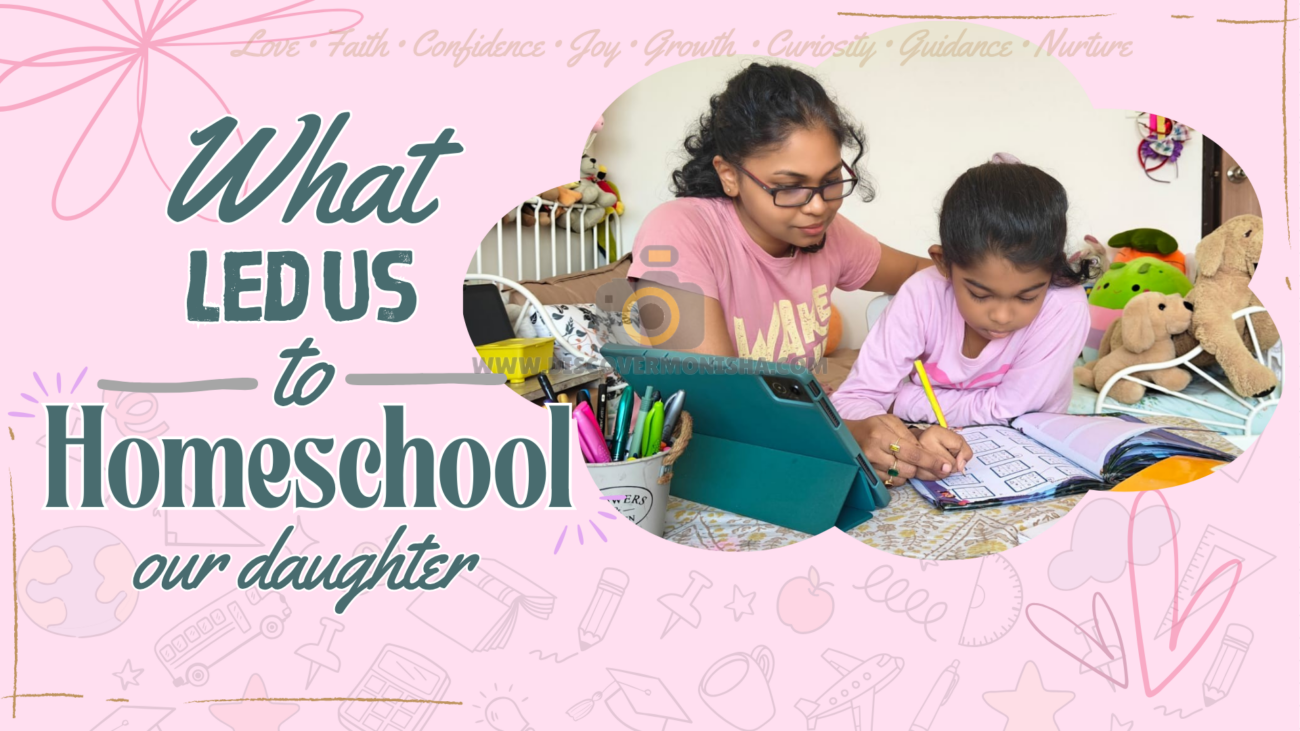
What Led Us to Homeschool our Daughter? 2025 | Part 1
Some choices in life aren’t planned—they unfold with time and clarity.
Homeschooling our daughter was one of them.
In this piece, you’ll find glimpses of our homeschool journey and the stories that shaped it.
HOMESCHOOLING IS A NON-TRADITIONAL APPROACH TO EDUCATION, WHERE PARENTS TAKE THE LEAD IN CREATING A MEANINGFUL AND SUPPORTIVE LEARNING ENVIRONMENT FOR THEIR CHILD.
EDUCATION, AFTER ALL, ISN’T JUST A SERIES OF COURSES—IT’S A CONTINUOUS JOURNEY THAT SHAPES LIFELONG GROWTH.
In this article, I share our experiences from our homeschooling journey, answering the questions of why, what, where, when, and how—along with a few commonly debated aspects.
I hope you find our journey both meaningful and inspiring.
(This article is divided into multiple sections.).
Part 2 is continued (link provided at the end of the article).
PATIENCE, ENDURANCE, FAITH, CONFIDENCE, FOCUS, AND CONSISTENCY
KEEP US GOING THROUGH EVERY STAGE OF THE LEARNING PROCESS.
I had never considered homeschooling until the COVID-19 lockdown made it a necessity. At that time, I had to take on the responsibility of educating my daughter, who was at a critical age for learning and preparing for the outside world. After two and a half years of being isolated from social interactions, I recognized the importance of creating a supportive environment at home during the lockdown.
I established a play zone, a study space, and a work area at home for both my husband and me; managing without any additional support became quite challenging. You can check out two vlogs detailing my journey into early preschool training at home through my youtube channel
Our experience: Understanding our daughter’s needs
1.
Our daughter was naturally cooperative in her learning, and I never felt the need to push her to understand things. She showed curiosity, attentiveness, spontaneity, and a sharp memory—qualities that felt more than enough for her early foundational years.
When the lockdown was announced, she was just 22 months old. At that time, I was preparing to enroll her in playschool so she could spend an hour interacting with other children. However, I always felt that I wouldn’t be comfortable leaving her for more than an hour or two. Being away from me for longer—especially in an unfamiliar environment with unfamiliar people—felt overwhelming for her at that age.
While some may have a different perspective, I personally felt that time spent with relatives and extended family is very different from being around strangers, and that distinction mattered to me.
2.
During the lockdown, she experienced a playschool-like setup at home, but without any real social interaction, as there were no other options at the time. Her growing needs encouraged me to create that environment at home, yet the real-life social interactions that typically begin at this age were something she missed.
We decided to enroll her in a nearby school for an online nursery program, anticipating that once the lockdown was lifted, she could transition smoothly to in-person schooling. Online education proved to be quite unfair for children, as it required a parent to be present during Zoom classes. I felt sorry for my child, having to navigate a chaotic environment with 30 kids sharing a single screen. It became clear to me that schools often prioritize profit over the genuine growth and development of children. To assess her progress during this period, I enrolled my daughter in several national competitions, and she emerged victorious, winning the national championship in the Play to Learn MARRS educational program. (You can find more on my Instagram profile @monisha_sd.)
3.
Being an architect, educator, and someone deeply connected to my field gave me the confidence and clarity to take things into my own hands. I refused to let my child suffer the same fate that I have witnessed for years. A bright, joyful, and gifted individual was being stifled by the chaotic and unethical online education systems we encountered with our daughter.
While we, like any parent, wished our daughter a joyful school experience, we would never sacrifice her carefree childhood for it.
We deeply value hard work—both I and my husband have built our paths through dedication. At the same time, we believe it is unfair to expect the same level of effort from young children, who are still learning, growing, and understanding the world in their own way.

4.
We successfully completed nursery, and then it was time for kindergarten (juniors). However, things took a turn for the worse. She struggled to adjust to the school and its environment, making it increasingly difficult for both my daughter and me.
Around the same time, my husband’s work demands increased—he would leave early and return late, especially as his industry was going through a difficult phase. Apart from weekends, our daughter deeply missed the time she used to spend with him in the mornings and evenings, and this began to affect her emotionally.
It was also a period of transition after the lockdown, and I had my own commitments to wrap up. Amidst everything, I did my best to support her through Junior KG.
Time passed quickly, but instead of things settling, we found ourselves facing more challenges and growing concerns.
5.
I reached a point of complete exhaustion. My career was demanding, and with my husband often unavailable due to work, I made the decision to step back from my high-pressure role to support our daughter as she adjusted to her new school.
We had enrolled her in one of the top schools in the country, and her transition into Senior KG came with its share of ups and downs. Still, I made it a point to pick/drop her off and be there for her every single day. It felt, for a moment, like the storm had calmed—but the bigger picture was yet to unfold.
During this time, I was also navigating health challenges and emotional strain. I was trying to hold myself—and everything around me—together with strength and quiet resilience.
The many roles I was carrying—as a mother without additional support, a professional, a wife, a daughter, a daughter-in-law, a friend, and a community manager—gradually became overwhelming. At one point, the weight of it all began to affect my health, pushing me to a place I had never imagined I would reach.
6.
The experience of Sr. KG was far from what I anticipated. Having completed my education in Mumbai, I was familiar with the local schools and took great care in selecting the right one for our daughter, as I intended for her to complete her education through grade 10 at the same institution. She excelled in Sr. KG, becoming a highly regarded and celebrated student in her class and school (overall).
However, her transition to Grade 1 was demanding, resembling the long hours of a corporate job, but at a child’s level. Despite her existing severe allergic rhinitis and being allergic to certain medicines, our daughter showed remarkable resilience in adapting to school life. She continued to attend classes despite the challenges, but as an educational professional, I observed the unfair treatment of children at this grade level.
It was disheartening to see her joy diminish and her childhood slipping away. Each day, she shared her concerns—concerns that seemed to echo what many other children were experiencing—leaving parents, including us, feeling helpless at times.
7.
I made every effort to connect with the school and requested greater understanding and support, as the transition to Grade 1 was a significant shift for the children. The sudden pressure was beginning to take a toll on their physical well-being.
For my daughter, this strain was clearly affecting her health, and I couldn’t bear to see such a courageous child begin to lose her confidence.
8.
One morning, she asked me a question that stayed with me:
“Mom, I hear everything you say… doesn’t my pain affect you?”
That moment made me pause. I gently spoke to her about the future in a way she could understand, sharing the possibilities and the pros and cons of both traditional schooling and homeschooling. At the end of the day, her future is my responsibility—no matter which path we choose.
I began exploring informal education more deeply, trying to understand how I could better support her. What she truly needed was my guidance, support, understanding, patience, and faith.
I shared my thoughts and research with my husband. He was initially uncertain, which was natural. But over time, through conversations and reflection, he began to see the bigger picture. Today, he feels confident that choosing to unschool our daughter was the right decision for us.

9.
Through various assessments and her own experiences, we came to understand that our daughter has a high learning ability and very little tolerance for monotony. She is expressive, observant, and quick to respond to situations. Her abilities were acknowledged and appreciated by both her school and teachers, yet she did not resonate with the traditional learning system.
However, she also went through a series of challenging experiences in a short span of time, which affected her emotionally. We chose to step back and give her the space she needed. With time, she began to heal.
Some of those experiences still require gentle understanding on her part. They may seem small to adults, but for a child, such feelings can linger. Often, it is only time, patience, and support that truly help them move forward.
10.
I’ve tried to keep this article brief, but it reflects nearly 2100 days of challenges in finding the right path for my daughter’s education. Over time, she herself became certain about wanting to be homeschooled—something that felt familiar to her, much like our earlier days, which she embraced with enthusiasm and an open mindset.
Having now experienced both traditional schooling and homeschooling, she has gained a perspective that allows us to openly discuss the advantages and limitations of different educational paths and life choices.
Initially, I was hesitant about stepping into informal education, especially considering its impact on my career. Yet, my faith remained strong. I believe a mother’s role is to support, understand, and guide her child to the best of her ability, regardless of circumstances.
Trusting my instincts, I chose to move forward—knowing that I had already faced and overcome far greater challenges in life.
CONTINUE READING PART 2 OF THIS ARTICLE
(CLICK HERE)
#HomeschoolingIndia
Here is the vlog, which covers up her graduation day ceremony towards the end.
What Led Us to Homeschool Our Daughter? 2025 | Part 1
#homeschoolingindia
Click here to have a glimpse of what our homeschooling days look like post unschooling – Youtube
To read more insights about our homeschool journey, please find the link below: –
- Essential Tips for New Homeschooling Parents | 2025 Indian Homeschooling | Part 2
- Common myths of homeschooling cracked | Indian Homeschooling 2025 | Part 3
- Drawbacks in Traditional Schooling | Which Educational Board? | Part 4
- Resource awareness for homeschooling parents | Part 5
- NIOS vs. SCHOOL | A tough choice for homeschoolers | Part 6
- Homeschool without vacation vs. school with vacation | Part 7